
Go to main content
shutterstock 796826071

Tourism projects: the importance of federal maritime-terrestrial zones

The federal maritime land zone (ZOFEMAT) is a highly relevant space for certain projects, as it is often the main attraction for some hotels and real estate developments in coastal areas, since it is linked to what is commonly known as the beach. 

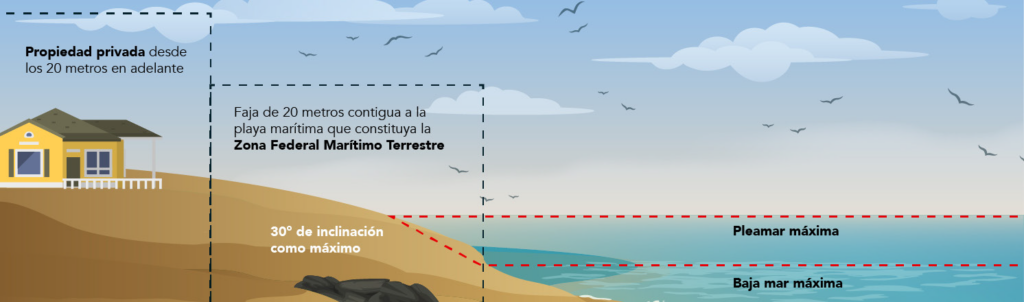
The ZOFEMAT is the 20-meter-wide strip of land delimited by the Ministry of Environment and Natural Resources (SEMARNAT) from the maximum sea level (known as high tide), which must be passable and with an inclination of no more than 30°. Once the ZOFEMAT ends, there are the privately owned areas. 

Federal Maritime Land Zone
 class =
Source: SEMARNAT

Although anyone can transit and use ZOFEMAT, if the intention is to have a private use to place some facilities or tourist works, such as swimming pools, beach clubs, sun loungers, among others, it is necessary to have a concession title issued by SEMARNAT. 

It is important to mention that obtaining such a concession title and complying with the terms, conditions and bases established therein is a complex task. Based on our experience in this matter, we would like to make the following recommendations: 

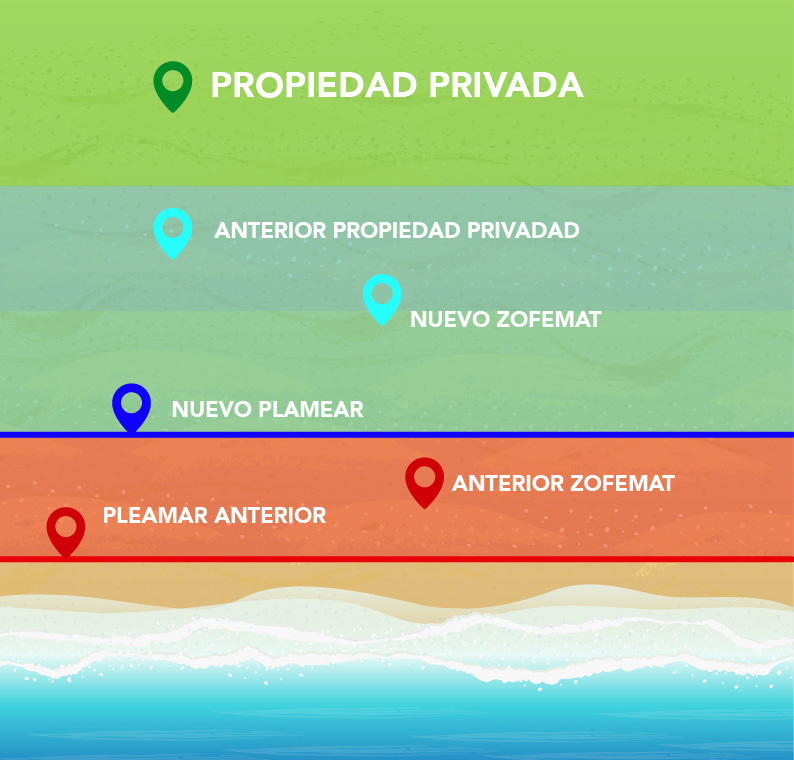
1. The ZOFEMAT changes according to the high tide. The maximum sea level is not definitive, therefore, the delimitation of the ZOFEMAT will depend on the delimitation carried out by SEMARNAT based on high tide. 
 class =

In this sense, if the high tide reaches land, SEMARNAT will establish a new delimitation of the ZOFEMAT, going inland. However, if the new delimited strip overlaps the property of third parties, these lands and their buildings will cease to be private property and will give way to the new ZOFEMAT, without any right to compensation for the former owner. 

Based on the above, it is recommended that properties neighboring the ZOFEMAT be aware of the boundaries that SEMARNAT may establish regarding high tide and the ZOFEMAT, especially if they have built any work directly in the ZOFEMAT or close to it. 

In the event that the ZOFEMAT affects private property, it is appropriate to request from the Secretariat the studies that led to the establishment of this new delimitation. If there is an error in these, it is possible to interpose some means of defense so that the authority recognizes the validity of the delimitation prior to the one that affects private property. 

2. Only one concession can be issued for each ZOFEMAT slot. This is one of the most common reasons why SEMARNAT may deny the concession title, since some concession applications have partial or even total overlaps with other concessions previously issued. 

3. It is not necessary to be the owner of the property adjacent to ZOFEMAT to obtain the concession on this strip. Anyone can apply for a concession title for a ZOFEMAT strip and carry out some economic activity in this area, for example, the provision of tourist services.

In this sense, if someone is a neighbor of the ZOFEMAT, it is recommended that they request the corresponding concession title from SEMARNAT to prevent third parties from carrying out economic activities in front of the property and, above all, so that in the future it is not the concessionaire who prohibits the development of economic activities in the ZOFEMAT by the owner of the neighboring property. 

4. There are no private beaches. Being the holder of a concession only gives the right to carry out certain economic activities in the ZOFEMAT, in addition to the fact that the assets built and/or placed in this area can only be used by those permitted by the concessionaire, for example the lounge areas or tourist facilities. However, prohibiting the passage or use of the ZOFEMAT by persons not involved in the tourist development is a reason for SEMARNAT to revoke the concession title and impose fines. 

5. Carrying out an economic activity in ZOFEMAT generates the obligation to obtain a concession title and pay fees. It is important to comply with this payment, as any non-compliance could lead to fines, updates and surcharges. 

6. The use of ZOFEMAT indicated in the concession must be respected. The applicable regulations establish three possible uses for this area: (i) protection or ornamentation, which is recommended for the development of environmental preservation activities, in this sense, economic activities cannot be carried out there; (ii) some productive activity, such as fishing, agriculture, among others; and (iii) general use, which allows the development of all economic activities, including the construction of some projects. 

It is important to mention that the payment of fees corresponds to the type of use for which the ZOFEMAT is intended. Fees in the protection and beautification area are quoted at up to MXN $45.57 per square meter, while for general use they amount to up to MXN $163.31 per square meter of ZOFEMAT.  

7. If ZOFEMAT is used without a concession title or with an expired concession, administrative, fiscal and criminal liabilities could arise. We recommend that you be aware of the high tide and ZOFEMAT boundaries established by SEMARNAT and the term of validity of the concession title, which, even if it is about to expire, can be extended. It is important to mention that the loss of a concession entails the loss of rights for a specific use in the ZOFEMAT. 

For the above reasons, it is recommended that the owners of the properties adjacent to ZOFEMAT obtain a concession title for it. In addition, adequate planning and legal advice are key to taking advantage of the use of this area, protecting the private property of adjacent projects and taking care of one of the main attractions of this type of project: the beaches. 

shutterstock 1718392996

New Organic Statute of the Mexican Petroleum Institute

Executive Summary:

  • On February 20, 2023, the Mexican Petroleum Institute (IMP) published its new Organic Statute.
  • This establishes a new organic structure, as well as the functions of each area that comprises it.
  • The new Organic Statute nullifies the previous statute published by the IMP on October 31, 2014.

On February 20, 2023, the Mexican Petroleum Institute (“IMP”) published, in the Official Gazette of the Federation (“DOF”), the new Organic Statute (“New Organic Statute”), through which a new organic structure and powers are established for each area that comprises it.

The New Organic Statute nullifies the previous Organic Statute published by the IMP in the DOF on October 31, 2014.

Legal Nature of the IMP

The IMP was created as a decentralized body by Decree published in the DOF on August 26, 1965. The New Organic Statute endorses the IMP as a decentralized public body of the Federal Public Administration, with its own legal capacity and assets, as well as technical, operational and administrative decision-making autonomy, sectorized to the Ministry of Energy.

Objective of the IMP

The new Organic Statute states that the IMP is a recognized public research center in the energy and hydrocarbon sector, whose purpose is to carry out research, technological development, innovation, scaling of processes and products, provision of technological services to optimize processes in the field of hydrocarbons (in exploration and extraction, in industrial transformation, and in transportation, storage and distribution), commercialization of its results in the energy sector, as well as carrying out specialized training.

IMP Activities

The New Organic Statute establishes the functions of the IMP, namely: 

  1. Provision of services for the efficient use of energy, clean fuels and the sustainability of the oil industry.
  2. Carry out the certification of processes and products.
  3. Conduct audits, supervision, evaluations, inspections, verifications and technical investigations in the areas of industrial and operational safety and environmental protection in the hydrocarbon sector. 
  4. Participate in the development of Mexican Official Standards and Emerging Standards.
  5. Carry out activities for the protection and commercialization of intellectual property, technological intelligence, management processes, technology transfer and knowledge management. 
  6. Carry out activities for conformity assessment, such as calibration, testing, auditing, inspection, certification and verification.
  7. Develop standards and instruments for the evaluation of competencies, as well as the implementation of the respective certifications, among others.

Administration and Organizational Structure

The New Organic Statute states that the IMP is directed and administered by a Governing Body, made up of a Board of Directors and a General Director, who acts as legal representative. 

The Board of Directors is made up of 10 (ten) directors, including the Secretary of Energy, two (2) independent directors and a representative for each of the following entities: Ministry of Finance and Public Credit, Ministry of Environment and Natural Resources, Petróleos Mexicanos, Universidad Nacional Autónoma de México, National Polytechnic Institute, Metropolitan Autonomous University and National Council of Science and Technology. 

The new Organic Statute also adds a structure for the exercise of its powers, which was not included in the previous Organic Statute (published in the DOF on October 31, 2014). The structure of the IMP will be as follows:

  1. General management
    • Legal Affairs Unit
  2. Research Directorate
  3. Technology Management
  4. Technology Marketing Directorate
  5. Exploration and Production Directorate
  6. Engineering and Services Department
  7. Training and Development Directorate
  8. Institutional Operations Directorate
  9. Finance and Administration Department
  10. Internal Control Body in the IMP

Finally, the New Organic Statute will come into force once it is published in the IMP's Internal Standards Library, rendering the previous Organic Statute published by the IMP ineffective.

Link to original post: https://www.dof.gob.mx/nota_detalle.php?codigo=5680109&fecha=20/02/2023#gsc.tab=0

shutterstock 1098811376

Recommendations for land use change in forest lands

Between 2001 and 2021, the country recorded the deforestation of 208,850 hectares, which is worrying if we consider that forest ecosystems are important because, among other environmental services, they sustain terrestrial biodiversity, help preserve the soil and capture carbon dioxide. This last function is key to addressing the current climate crisis. 

The development of mining, real estate, tourism, industrial, agricultural and other projects involves the clearing of vegetation on forest land, which is known as “land use change on forest land”, and requires the adoption of measures to prevent, mitigate and/or compensate for adverse environmental impacts. For example, through reforestation of larger areas in relation to the cleared area. 

In order to reduce the adverse environmental effects of land use changes on forest lands, forestry regulations have designed a series of legal requirements. Based on Santamarina + Steta's professional experience in this area, we would like to make the following recommendations: 

  1. The best impact is the one that is not caused. When considering a property for the development of a project, it is recommended to prefer land that has already been cleared, for example, agricultural, urban or legally impacted areas. 
  1. Any land with native vegetation in a good state of conservation is forest land. There is a misconception that only temperate forests are forest ecosystems. This error could lead to illegal logging in jungles, wetlands, arid and semi-arid zones, assuming that these ecosystems are not forests. The arid and semi-arid vegetation typical of northern Mexico is perhaps the one that suffers the most from this confusion, since, as it is not made up of trees, it is common for it to be cut down without the corresponding authorizations. 
  1. Changes in land use on forest land must be made through two authorizations. Anyone who intends to cut down forest land must process and obtain an environmental impact permit (AIA) and an authorization for change of land use on forest land (ACUSTF). Logging with only one permit or without any of these is illegal. 
  1. The terms and conditions imposed by the AIA and ACUSTF must be complied with. Both permits impose a series of obligations on their holders that must be fulfilled, for example, carrying out actions to relocate fauna on the land, rescue flora in some degree of protection or reforestation on other lands.
  1. The lands where native vegetation regeneration begins are also considered forest lands. In these cases, it is advisable that a forestry expert, duly registered in the National Forestry Registry, determine whether the land is considered forested or not. 
  1. It is not possible to cut down or prune mangroves or vegetation found within a 100-meter strip adjacent to the mangrove. Mangroves are a protected species, so the environmental authority is legally prohibited from granting AIAs and ACUSTFs that allow their felling or pruning. It is possible to generate technical and legal strategies so that the authority reduces the 100-meter strip adjacent to the mangrove and allows the felling of vegetation.  
  1. Owners of forest land that has been burned or illegally logged will not be able to obtain an ACUSTF for a period of 20 years.  In the preparatory stage of a project, it is advisable to verify whether there was or is forest vegetation on the property where the development is planned and, if applicable, that said vegetation has not been affected by a fire or illegal logging. 
  1. Penalties for logging without an AIA and/or an ACUSTF or failing to comply with the obligations of these authorizations can end the viability of a project. In addition to the potential environmental, administrative and criminal liability for those who commit illegal logging or fire, such violations may result in the obligation to repair the environmental damage caused. This implies the execution of all the actions necessary to return the forest land to its state prior to the damage caused and substantial reforestation measures. In addition, as already noted, in the 20 years following the violation, an ACUSTF cannot be obtained for the affected property.  

Adequate legal and technical planning is key to ensuring that the development of projects on forest lands is carried out in a sustainable manner, in full legal compliance and helping to preserve these ecosystems.  

bigstock A Man Breaks Contact Between P 442145756

General Law on Alternative Dispute Resolution Mechanisms

Executive Summary:

  • Senator Sánchez Cordero presented to the Senate a draft bill to issue the “General Law on Alternative Dispute Resolution Mechanisms.”
  • This initiative aims to redirect the justice system in Mexico to give preference to MASC over traditional litigation.
  • The objective is to provide prompt and effective solutions to disputes between individuals and companies, avoiding having to exhaust a judicial process, with the savings in time and economic resources that this represents for the parties.

Senator Olga Sánchez Cordero recently presented to the Senate a draft proposal for a Decree to issue the “General Law on Alternative Dispute Resolution Mechanisms.”

This initiative is based on the reforms to articles 17 and 73 of the Constitution that took place in 2008 and 2017, which seek to promote the resolution of disputes through alternative means. 

In this regard, on February 5, 2017, a Decree was published amending the Federal Constitution to grant Congress the power to issue a General Law on Alternative Dispute Resolution Mechanisms (“ADR”). Despite various proposals for the implementation of a General Law on the matter, this has not been achieved to date.

In this sense, Senator Sánchez Cordero's initiative aims to materialize the constitutional reform of 2017, proposing a General Law that regulates the MASC. In this sense, the initiative seeks to redirect the justice system in Mexico to give preference to the MASC over traditional litigation.

The above proposes, for example, that before starting a trial, the interested party has the option of entering into a dialogue with their counterparty to reach an agreement that benefits all those involved and, thus, avoid having to process a "traditional" litigation before the Courts. 

The aim of this is to provide prompt and effective solutions to disputes between individuals and companies, avoiding having to exhaust a judicial process, with the savings in time and economic resources that this represents for the parties.

The aforementioned draft law can be consulted here.

If you have any questions about the content of this article or would like to delve deeper into the implications of the General Law on Alternative Dispute Resolution Mechanisms initiative, please do not hesitate to contact our experts.

bigstock Production Of Fuel And Electri 473361483

CRE resumes legal deadlines and terms after suspension of deadlines due to COVID-19

Executive Summary:

  • After almost three years of suspension of the Energy Regulatory Commission's deadline and timeframe activities due to the pandemic caused by Covid-19, these activities are being resumed.
  • It is proposed that deadlines be resumed in an orderly and staggered manner starting on March 1, 2023. 
  • The resumption will be carried out in different stages and in a progressive manner in order to guarantee the continuity of the administrative processes and procedures, as well as compliance with the obligations and responsibilities of the CRE and the users of the energy sector.

Agreement A/001/2021, published on January 18, 2021, established the suspension of legal deadlines and terms of the Energy Regulatory Commission (“CRE”) as a measure to prevent and combat the spread of the COVID-19 coronavirus. This measure was adopted to avoid the concentration of people and reduce the risk of contagion of the virus among CRE employees and the general population. However, this measure affected all procedures, formalities and actions before the CRE.

Accordingly, on February 28, 2023, the CRE published Agreement A/004/2023 (“the Agreement”) in the Official Gazette of the Federation (“DOF”). The Agreement establishes the resumption of the legal terms and deadlines, which were suspended as a measure to prevent and combat the spread of COVID-19. An orderly and staggered resumption of deadlines is proposed starting March 1, 2023. 

The resumption of legal deadlines and time limits will be carried out in different stages and in a progressive manner, in order to guarantee the continuity of administrative processes and procedures, as well as compliance with the obligations and responsibilities of the CRE and the users of the energy sector.

The Agreement establishes that in the case of pending applications that were submitted before the entry into force of this agreement, they will be followed up according to the order of priority that will be published by category on the official website of the Energy Regulatory Commission (CRE): www.cre.gob.mx.

On the other hand, applications submitted after the entry into force of this agreement will be handled based on the processing folio number assigned to them through the link https://ope.cre.gob.mx/It is important to note that the Agreement limits the number of applications to one per month per individual or legal entity. This limitation, in addition to violating the rights of permit holders and with which the CRE goes beyond the provisions provided by the Law on the matter, generates legal uncertainty for all regulated subjects, in particular for those legal entities that have more than one permit.

Regarding the folios assigned for handling procedures, these will be available to interested parties five business days before the corresponding month, except for March 2023, when they will be available during their first five business days.

The assignment of folios will be carried out as follows:

  • 50 pages per month regarding hydrocarbons.
  • 15 pages per month on the subject of electricity.
  • 120 monthly pages for pre-registrations.

The assignment of such folios represents significant risks for the fulfillment of some obligations derived from their permits as they are limited to a single application per legal entity. 

It is worth mentioning that, in the Agreement, the CRE provides that in order to comply with what it establishes, it is necessary to carry out actions with the available human, material and financial resources that allow to attend simultaneously, orderly and in a staggered manner both the usual operation of said agency, as well as the pending matters generated by the suspension of deadlines, in accordance with the priority, considering the public interest, the principle of first in time first in law, the general principles of law, non-unduly discriminatory treatment and attention in accordance with what is humanly possible. However, at no time does it consider the negative consequences that the provisions provided for by the system of granting folios will represent for permit holders who have more than one permit.

Links to the publication:

Tiles

Grupo Industrial Saltillo completed the sale of its Vitromex business

Grupo Industrial Saltillo completed the sale of its Vitromex business to Mohawk Industries with the advice of Santamarina + Steta.

Carlos Argüelles and Lisa Carral led the legal team that supported Grupo Industrial Saltillo in the transaction, from the preparation stage, legal audit, negotiation of the purchase agreement and closing of the transaction.

Vicente Grau A., Iván Szymanski and Sofía Ramírez, for their part, participated as advisors in the notification of concentration before the Federal Economic Competition Commission.

Santamarina + Steta Team:

bigstock Hand Of A Man Holding Mexican 460247795

Northern Business Promoter issues stock certificates

Promotora Empresarial del Norte, SA de CV (“Prensa”) obtained from the National Banking and Securities Commission the authorization letter to register in the National Securities Registry a dual program of short and long-term stock certificates for a maximum amount of $1,000,000,000.00 (One billion Pesos 00/100 National Currency), with a revolving nature (the “Program”).

Under the Program, Prensa carried out the first issue of long-term stock certificates for the amount of $392,082,700.00 MN (Three hundred ninety-two million eighty-two thousand seven hundred Pesos 00/100, National Currency). Actinver Casa de Bolsa, SA de CV, Grupo Financiero Actinver acted as the intermediary for the transaction.

Santamarina + Steta, with the support of the team led by Diego Ostos, José Antonio López y Sebastian Samayoa, acted as legal advisor to the station in this process.

bigstock Mexico Flag With Statue Of Lad 466370153

Electoral Reform Plan B

Executive Summary:

  • On March 2, 2023, the Decree issuing the General Law on the Means of Appeal in Electoral Matters, known as the “Plan B"of electoral reform. 
  • These modifications directly affect the 2024 electoral processes.
  • These electoral laws are expected to be challenged through unconstitutionality actions before the Supreme Court of Justice of the Nation. 

On March 2, 2023, the Decree reforming, adding and repealing various provisions of the General Law of Electoral Institutions and Procedures, the General Law of Political Parties and the Organic Law of the Judicial Branch of the Federation, and issuing the General Law of the Means of Appeal in Electoral Matters, known as the "Plan B” of the electoral reform. These modifications directly affect the electoral processes of 2024.

The reforms include a significant restructuring of the composition of the National Electoral Institute (INE); a reduction in its budget, number of employees and closure of various offices; the narrowing of the concept of “government propaganda”, opening up the possibility of government promotion during electoral campaigns; and the reduction of sanctions for candidates. 

In this regard, the main effects of the reform are the following: 

  • Greater absence of polling station officials and less training for them.
  • Risk of annulling elections due to failure to set up 20% of the required voting stations in a district. 
  • Reduction in the number of personnel trained to count votes. 
  • Impacts on the organization of elections and citizen participation mechanisms. 

These electoral laws are expected to be challenged through unconstitutionality actions before the Supreme Court of Justice of the Nation, with the following having procedural standing to file such actions: the National Human Rights Commission, 33% of the legislators of each of the Chambers of the Congress of the Union, the political parties registered with the INE and the INE itself. 

In order for such reforms to be declared unconstitutional, in whole or in part, a qualified majority of eight votes from the justices who make up the Plenary of the Supreme Court is required. 

Notwithstanding the above, it is important to mention that the INE filed an electoral trial against the reforms before the Superior Chamber of the Electoral Tribunal of the Judicial Branch of the Federation. 

shutterstock 1414052297

Decree on glyphosate and genetically modified corn

Executive Summary:

  • On February 13, 2023, a decree was published establishing actions aimed at eliminating the use, sale, distribution, promotion and importation of glyphosate, agrochemicals containing it as an active ingredient, and genetically modified corn.
  • Federal Public Administration agencies must refrain from acquiring, using, distributing, promoting and importing genetically modified corn, as well as glyphosate.
  • Biosecurity authorities must also revoke and refrain from granting permits and authorizations related to genetically modified corn seeds and grains.

On February 13, 2023, the “Decree establishing various actions regarding glyphosate and genetically modified corn” (the “Decree”) was published in the Official Gazette of the Federation, which entered into force the day after its publication.

The Decree establishes the actions that must be carried out by the agencies and entities of the Federal Public Administration, in order to eliminate the use, sale, distribution, promotion and importation of glyphosate, agrochemicals that contain it as an active ingredient and genetically modified corn.

For the above reasons, the Federal Public Administration agencies are ordered to refrain from acquiring, using, distributing, promoting and importing genetically modified corn, as well as glyphosate or agrochemicals that contain it as an active ingredient.

In this same sense, the Decree orders the biosecurity authorities to revoke and refrain from granting permits for the release into the environment of genetically modified corn seeds and authorizations for the use of genetically modified corn grain.

Likewise, in relation to the use of genetically modified corn for animal feed and the industry for human food, the deadline for prohibiting its use (January 31, 2024) is eliminated, until such time as a gradual substitution of said corn is made and there is sufficient supply.

In order to support the measures implemented, the authorities invoke the alleged harmful effects of glyphosate on human health, the environment and biodiversity, as well as on the human right to nutritious, sufficient and quality food and the protection of native corn, milpa, biocultural wealth, peasant communities and gastronomic heritage.

Finally, the Decree repeals the various "Decree establishing the actions to be carried out by the agencies and entities that make up the Federal Public Administration, within the scope of their powers, to gradually replace the use, acquisition, distribution, promotion and importation of the chemical substance called glyphosate and the agrochemicals used in our country that contain it as an active ingredient, with sustainable and culturally appropriate alternatives, which allow maintaining production and are safe for human health, the country's biocultural diversity and the environment" published in the Official Gazette of the Federation on December 31, 2021.

We consider that the Decree suffers from various constitutional defects that could lead to it being left without effect by the Judicial Branch of the Federation, if the corresponding means of defense are promoted against it.

bigstock Accountant Holding A Pen arro 473003587

Can VAT be credited in compensation as a means of extinguishing obligations?

Executive Summary:

  • In August 2022, the Plenary Session of the Sixteenth Circuit on Administrative Matters resolved that the figure of compensation applicable in civil law is not a means of payment to credit VAT. Until now, it was a mandatory criterion only in the state of Guanajuato.
  • A Collegiate Court in the State of Coahuila issued a thesis to the effect that there is no legal prohibition to consider creditable and effectively paid the VAT that is transferred between individuals that has compensation as its origin.
  • On March 15, 2023, the Second Chamber of the Supreme Court of Justice of the Nation will resolve the conflict of criteria. A decision that will be binding throughout the country.

In August 2022, the jurisprudence issued by the Plenary Session on Administrative Matters of the Sixteenth Circuit was published, through which it resolved that, for the purposes of analyzing the admissibility of a request for a refund of a credit balance, the figure of compensation applicable in civil law is not a means of payment to credit the value added tax.

This criterion is mandatory only in the state of Guanajuato, causing many companies in that region to stop using compensation as a means of payment, which has affected their operation and business model with clients and suppliers.

However, a Collegiate Court in the State of Coahuila, when resolving two direct amparos, issued a thesis to the effect that there is no legal prohibition to consider creditable and effectively paid the value added tax that is transferred between individuals by virtue of operations carried out between them that have compensation as their origin.

Given the contradiction of both criteria, the Second Chamber of the Supreme Court of Justice of the Nation will be responsible for making the final decision on March 15 on whether compensation is a means of payment for VAT and, therefore, whether when using this method it is possible or not to credit the tax or request a refund of the balances generated. This decision will be mandatory throughout the country.

If the Supreme Court does resolve this situation, its ruling will be of great importance, since the compensation figure is used by many companies that would be affected if the criterion that is currently only mandatory in the state of Guanajuato were followed.

The consequences of such a resolution must be analyzed in each particular case, especially the harmful impact it may have on inter-company operations, for example, in a centralized treasury, loans, among others.

The Santamarina + Steta Tax team is at your service to provide you with the necessary advice.

shutterstock 1729525240

Unconstitutionality of the absolute prohibition of the commercialization of cannabis

Executive Summary:

  • The First Chamber of the Supreme Court issued the thesis “Absolute prohibition of the commercialization of cannabis classified as a narcotic. Articles 234, 235 and 235 bis of the General Health Law that establish it violate the human rights to freedom of trade and work.".
  • It was decided that the absolute prohibition of the commercialization of cannabis violates the rights to freedom of trade and work by not passing the proportionality test and the degree or sub-principle of necessity.
  • This precedent lays the groundwork for the creation of a new market for the marketing of cannabis between producers and the general public.

On March 3, 2023, the thesis 1a. III/2023 (11a.) under the heading “Absolute prohibition of the commercialization of cannabis classified as a narcotic. Articles 234, 235 and 235 bis of the General Health Law that establish it violate the human rights to freedom of trade and work." issued by the First Chamber of the Supreme Court of Justice of the Nation when resolving the amparo review 461/2020 (available at the following link: https://sjf2.scjn.gob.mx/detalle/tesis/2026073).

In this precedent, it is determined that the content of articles 234, 235 and 235 Bis of the General Health Law has a negative impact on the fundamental rights to commerce and work, since it constitutes an obstacle for individuals to lawfully exercise the actions of commercialization of hemp classified as a narcotic, considering that the proportionality test is not passed, in its nuance of necessity.

In this regard, the Supreme Court considered that the absolute prohibition of the commercialization of cannabis is an unnecessary measure, since it absolutely prevents its commercialization for industrial purposes, when in order to achieve the objectives intended by the prohibition (protection of health) it could be limited to implementing a series of measures similar to those provided for medical and/or scientific purposes, such as authorization, monitoring, control, prevention and phytosanitary measures.

Likewise, it is relevant to note that when resolving the amparo in review 461/2020, the First Chamber of the Supreme Court of Justice of the Nation issued a diverse thesis of the heading "Absolute prohibitions contained in the General Health Law on different activities related to cannabis or marijuana. Scope of application of the proportionality test”, available at the following link: https://sjf2.scjn.gob.mx/detalle/tesis/2026074).

In this precedent, it was determined that although it has been the criterion of the Supreme Court that legislative restrictions that affect economic freedoms must be controlled by an ordinary test or one of mere reasonableness, which is less demanding than the proportionality test, in the case of the regulatory circuit established in the General Health Law related to cannabis, it must be specified that this standard of lax scrutiny is applicable to that legislation to regulate an economic activity, not to prohibit it totally. In this sense, it was determined that in the case of absolute prohibitions contained in the General Health Law, it is appropriate to subject them to a proportionality test as opposed to the ordinary one.

Based on the above, we consider that the theses recently published by the Supreme Court and those that determined the legality of recreational cannabis use lay the foundations for the creation of a new market related to large-scale production and marketing of cannabis to the general public, provided that the limits established in the applicable legislation are complied with.

The above, given that the Supreme Court of Justice of the Nation, when applying the proportionality test, has been emphatic and consistent in determining that there are other, less burdensome, measures for the protection of people's health, with regard to the activities of the previous phases of the cannabis production chain and activities related to its commercialization. 

shutterstock 510229612 1

CNH publishes new guidelines on assignments, corporate changes and liens in hydrocarbon exploration and extraction contracts

Executive Summary:

  • On March 8, 2023, the National Hydrocarbons Commission published Agreement CNH.E.89.010/2022 by which the Guidelines for Assignments, Corporate Changes and Liens are issued.
  • The Guidelines are applicable to contracts for the exploration and extraction (CEE) of hydrocarbons and repeal the previous guidelines that establish the requirements and the procedure for entering into alliances or associations in which the transfer of corporate and management control or control of operations is carried out, with respect to hydrocarbon CEEs.
  • The Guidelines will enter into force on March 9, 2023.

On March 8, 2023, the National Hydrocarbons Commission (“CNH”) published, in the Official Gazette of the Federation (“DOF”), Agreement CNH.E.89.010/2022 by which the Guidelines for Assignments, Corporate Changes and Liens (“Guidelines”) are issued.

The Guidelines are applicable to contracts for the exploration and extraction (“CEE”) of hydrocarbons. In addition, they repeal the previous guidelines that establish the requirements and procedure for entering into alliances or associations in which the transfer of corporate and management control or control of operations is carried out, with respect to hydrocarbon CEE, published in the DOF on January 30, 2017, as well as its modification published in the DOF on December 17, 2020.

Relevant Aspects

The Hydrocarbons Law states that the CNH must authorize, in advance, any partial or total transfer of operations, corporate control of a Contractor (1) and/or the rights conferred under hydrocarbon EECs.

Based on the experience acquired by the CNH in recent years, these new Guidelines are issued with the aim of regulating more efficiently the review and approval procedure of the following “Procedures”:

  • (i) Applications to accredit the legal, financial, technical, experience and execution capacities of the Contractors;
  • (ii) Applications for authorization to enter into alliances or associations in which corporate and management control or control of operations is transferred;
  • (iii) Applications to impose liens on the Participating Interest (2), and
  • (iv) Notices of changes in share capital or Participation Interest.

Among the most relevant topics of the Guidelines are the following:

  1. Regarding the request for accreditation of capabilities, the person who, in relation to his CEE, intends to carry out an assignment, to be part of a Contractor or intends to modify the structure of the share capital, whether fixed or variable, of an individual Contractor or a Participating Company (3) and which involves the departure of the jointly liable party, the CNH must be asked to evaluate the legal, financial, technical, experience and execution capacities of the potential assignee, the potential contractor or the potential jointly liable party.
  2. Regarding the requirements for the transfer request, the Contractor shall submit an application for authorization of an assignment, by filling out forms and providing specific information and documentation, aimed at formalizing the agreements for the transfer of corporate and management control or the transfer of control of operations, as appropriate, and formalizing the amendment agreement to the CEE. In this sense, the definition of corporate and management control is not limited to direct control, but also includes indirect control up to the level of the company through which the Contractor or the Participating Company has accredited technical and financial capabilities.
  3. Regarding the notice of change in the share capital structure of an individual Contractor or a Participating Company, which does not result in a transfer of corporate and management control, must notify the CNH of its completion by completing forms and providing specific information and documentation. In the event that said modification implies the departure of the jointly liable party, the Contractor or the new jointly liable party must prove that it maintains the same financial and, where applicable, technical, experience and execution capabilities as those demonstrated by the outgoing jointly liable party.
  4. Regarding the notice of modification of the Participation Interest percentages between Participating Companies that make up a Contractor and that does not result in a transfer of corporate and management control or control of operations, the CNH must be notified of its completion by filling out forms and providing specific information and documentation.
  5. Regarding the request to tax the Participation Interests, the CNH must give its consent for a Lien to be established (4) on part or all of the Participating Interest. The creation of a CNH Lien will be carried out by providing specific information and documentation. Likewise, the Guidelines establish the need to give notice to the CNH regarding the formalization, modification or termination of a Lien. In this regard, a definition of Creditor is included, as the persons in favor of whom a Lien is created.
  6. Inclusion of new formats for the presentation of the information required for the Procedures.

Each procedure will be subject to payment of the corresponding fees and will have a specific procedure for the CNH to issue the respective resolution, with applicants having periods to correct any objections that the CNH may make. This is without prejudice to the CNH being able to deny any of the requested procedures.

The Guidelines will enter into force on March 9th 2023; However, the procedures initiated before the CNH prior to the entry into force of the Guidelines will be processed in accordance with the previous regulations in force at the time of submission of the corresponding procedure.

Notes:

(1) Defined in the Guidelines as the person signing the Contract individually or Participating Companies or signatories of the CEE, jointly, as appropriate.

(2) Defined in the Guidelines as the undivided share of each of the Participating Companies in the rights and obligations of the Contractor under a CEE entered into in a consortium or joint venture. In the case of individual Contractors, their Participating Interest is one hundred percent (100%).

(3) Defined in the Guidelines as each of the Persons signing the CEE, including the operator, who together constitute a Contractor.

(4) Defined in the Guidelines as the legal act entered into between the individual Contractor or the Participating Company, as applicable, and the Creditor, by which an obligation to give, do or not do with respect to the Participating Interest is established, and may consist of all types of guarantees in terms of the Guidelines.