Go to main content
bigstock Justice And Law Concept Legal 474745349

CRE modifies transitional articles of NOM-001-CRE/SCFI-2019

January 2023 | printable version

Executive Summary

  • On January 13, 2023, the Energy Regulatory Commission published the Agreement modifying the transitional articles of the Mexican Official Standard NOM-001-CRE/SCFI-2019, Electric energy measurement systems - Meters and measurement transformers - Metrological specifications, test methods and procedure for conformity assessment.
  • The NOM specifies the period that manufacturers, Transporters and Distributors have for the installation of meters and measurement transformers.
  • It is important to remember that Transporters and Distributors must only use and install measuring instruments that have obtained a model or prototype approval in accordance with the provisions of the Federal Law on Metrology and Standardization and the corresponding Mexican Official Standard. 
  • The Agreement entered into force on 16 January 2023.

On January 13, 2023, the Energy Regulatory Commission (“CRE”) published on the portal of the Official Gazette of the Federation (“DOF”), the Agreement that modifies the transitional articles of the Mexican Official Standard NOM-001-CRE/SCFI-2019 (“NOM”), Electric energy measurement systems - Meters and measurement transformers - Metrological specifications, test methods and procedure for conformity assessment (“Agreement”)1.

Through this Agreement, the Second and Fifth Transitory Articles of the NOM were eliminated, which implies that the date of entry into force of the NOM changes, and instead of entering into force 365 days after its publication, it will enter into force the day after its publication, anticipating the assumptions that the measuring equipment must comply with as of January 2025.

In addition, this Agreement specifies the period of time that manufacturers, Transporters and2 and the Distributors3 for the installation of meters and measuring transformers.

It should be noted that Article 113 of the Regulations of the Electric Industry Law (“RLIE”) states that Transporters and Distributors must only use and install measuring instruments that have obtained a model or prototype approval in accordance with the provisions of the Federal Law on Metrology and Standardization and the corresponding Mexican official standard. They must also verify, through the then called accredited and approved verification units —now inspection units in accordance with the Electric Industry Law—, at least once every three years, the installed measuring instruments to ensure that they comply with the established accuracy.

Through the Agreement, the CRE makes the following modifications to the transitional articles of the NOM:

  • Meters and measuring transformers that do not have model or prototype approval and the certificate of compliance with the NOM may be purchased, marketed and used until January 1, 2025. On the other hand, meters and measuring transformers that have model or prototype approval and the certificate of compliance prior to January 1, 2025 may be purchased, marketed and used at any time.
  • Meters and measuring transformers, which must comply with the NOM, must be installed starting January 1, 2025. However, equipment that Transporters and Distributors prove to have acquired prior to January 1, 2025 may be installed and used during its useful life, as long as it maintains the metrological characteristics with which it was originally acquired.
  • Distributors must ensure that meters installed before January 1, 2025 for active and reactive energy measurements of medium voltage services with loads greater than or equal to 100 kW comply with the following accuracy values ​​within a maximum period of 60 months from the entry into force of the NOM:
+/- 1.0 % for meters of accuracy class 0.5 
+/- 0.4 % for meters of accuracy class 0.2

  • Transporters must ensure that meters installed prior to January 1, 2025, for active and reactive energy measurements of high voltage services comply with the following accuracy values ​​within a maximum period of 60 months from the entry into force of the NOM:
+/- 1.0 % for meters of accuracy class 0.5
+/- 0.4 % for meters of accuracy class 0.2 
  • Test reports prior to 1 January 2025 may be used for certification purposes, subject to technical review and validation of the results by a Certification Body.
  • Test reports issued prior to 1 January 2025 may be used for the purposes of approving the model or prototype, subject to technical review and validation by the National Metrology Centre.
  • Testing Laboratories, Certification Bodies and Inspection Units may now begin the process of accreditation and approval of the NOM.

The Agreement entered into force on 16 January 2023. To consult the original publication, please visit: https://www.dof.gob.mx/nota_detalle.php?codigo=5676875&fecha=13/01/2023#gsc.tab=0

1 The Agreement is available for consultation at: https://www.dof.gob.mx/nota_detalle.php?codigo=5676875&fecha=13/01/2023#gsc.tab=0
2 CFE Transmission.
3 CFE Distribution.

LogosCFE 500 Directory

Modification to the Organic Statute of CFE Generation V

January 2023 | printable version

Executive Summary

  • CFE Generación V is the CFE's Subsidiary Productive Company that carries out the generation activities covered by the independent energy production contracts signed by CFE, through the Legacy External Power Plants, as well as representing said Legacy External Power Plants in the Wholesale Electricity Market.
  • On January 16, 2023, the Federal Electricity Commission published the Agreement in which the Organic Statute of CFE Generación V is modified.
  • The Agreement grants new powers to the Sub-Management of Services and Financial Analysis of CFE Generación V, in matters of contracting goods and services.

CFE Generación V is the CFE's Subsidiary Productive Company whose purpose is to carry out the generation activities covered by the independent energy production contracts signed by CFE, through the Legacy External Power Plants, as well as to represent said Legacy External Power Plants in the Wholesale Electricity Market.

On January 16, 2023, the Federal Electricity Commission (“CFE”) published, in the Official Gazette of the Federation (“DOF”), the Agreement in which the modification is made to the Organic Statute of CFE Generación V, published on June 12, 2020 (“Agreement”).

This Agreement grants new powers to the Sub-Management of Financial Services and Analysis (“Sub-Management”) of CFE Generación V, in matters of contracting goods and services.

New Powers

The Organic Statute of CFE Generation V1 It indicates that the Sub-Management is made up of the Financial Analysis Department and the Administrative Services Department of said Subsidiary.

The original powers of said Sub-Management are provided for in Article 14.2 of the Organic Statute of CFE Generación V and, through the Agreement, eleven new powers are granted to said Sub-Management through the addition to Article 17 of the Organic Statute of CFE Generación V.

The new powers consist of the following:

  1. Preparation of needs studies related to the goods and services required by CFE Generación V to have good planning for the places where a project is intended to be located.
  2. Preparation of market conditions research for the goods and services required by CFE Generación V to review the importance of the market and have proper planning for it. 
  3. Review and validation of the information recorded by the CFE Generation V areas for the integration of the Annual Contracting Program before it is sent to the CFE Intelligence and Market Analysis Management.
  4. Report to the CFE Intelligence and Market Analysis Management the information registered by the CFE Generation V requesting areas in the electronic system determined for the integration of the Annual Contracting Program.
  5. Preparation of Market Conditions updates regarding the procurement of goods and services to be carried out by CFE Generación V.
  6. Design of the requirements related to the procedures for contracting goods and services that CFE Generación V will carry out.
  7. Determine the suitability of contract modifications developed by CFE Generación V, when it involves the replacement of goods.
  8. Dissemination of the rules applicable to market intelligence processes issued by the Board of Directors or the Corporate Administration Directorate of the CFE.
  9. Provide information to CFE Generación V and to the CFE Market Intelligence and Analysis Department on the general results of the Market Intelligence processes. These results support the creation of a global analysis of the operation's costs as well as the planning of market strategies. 
  10. Collaboration with the CFE's Market Intelligence and Analysis Department when conducting verifications on compliance with the rules applicable to market intelligence processes. 
  11. Any other assumption that is applicable according to the law. 

The powers previously granted to the Sub-Management, indicated in sections I to XII of article 17 of the Organic Statute of CFE Generación V, are not affected by this Agreement.

The Agreement entered into force on 17 January 2023. To consult the original publication, please visit: https://www.dof.gob.mx/nota_detalle.php?codigo=5677167&fecha=16/01/2023#gsc.tab=0

1. The Organic Statute of CFE Generation V was published in the DOF on June 12, 2020 and is available for consultation at: https://www.dof.gob.mx/nota_detalle.php?codigo=5594923&fecha=12/06/2020#gsc.tab=0

2. Article 14 of the Organic Statute of CFE Generación V sets out the general powers of all the Sub-Managements of CFE Generación V, including the Sub-Management that is the subject of this document.

profiles in gobmx CP directory

Leopoldo Vicente Melchi García repeats as President Commissioner of the CRE

January 2023 | printable version

Executive Summary:

  • Leopoldo Vicente Melchi García was appointed as President Commissioner of the CRE for the second time, having previously held this same position from 2019 to December 31, 2022.
  • Leopoldo Vicente Melchi García will serve a seven-year term, ending on December 31, 2029.
  • It can be expected that the government will continue to pursue the current administration's energy policy, strengthening state-owned productive companies to the detriment of private participation in the energy sector. 

As Santamarina + Steta anticipated in the Update “Shortlist for the appointment of the President Commissioner of the Energy Regulatory Commission”, published on January 10, 2023, on January 18, 2023, the Permanent Commission of the Congress of the Union approved the appointment of Leopoldo Vicente Melchi García as President Commissioner of the Energy Regulatory Commission (“CRE”) with 35 votes in favor and two abstentions. Leopoldo Vicente Melchi García will serve as President Commissioner for a period of seven years, so his term will end on December 31, 2029.

Leopoldo Vicente Melchi was the winner from among the three candidates that the Federal Executive presented to the Senate on January 4, 2023. The other two candidates were Alfonso López Alvarado and Victor David Palacios Gutiérrez.

 class =

Leopoldo Vicente Melchi García is a Chemical Engineer from the Universidad Veracruzana, with diplomas in Administration from the Pan-American Institute of Senior Business Management, in Environmental Policy Instruments and Environmental Protection from the Universidad Autónoma Metropolitana, and in Efficient Use of Water and Quality Control from the Universidad Nacional Autónoma Metropolitana. Universidad Nacional Autónoma de MéxicoHe served as President Commissioner of the CRE since 2019 and concluded his first assignment on December 31, 2022. During his first assignment as President Commissioner of the CRE, Melchi worked closely with SENER, and the process of issuing new permits to private participants in the oil and electricity sectors was paused.

Leopoldo Vicente Melchi García can be expected to continue the current administration's public energy policy, strengthening state-owned productive companies to the detriment of private participation in the energy sector. 

It is worth noting that the CRE has an additional vacancy for a Commissioner position, since Luis Guillermo Pineda Bernal ended his term on December 31, 2022.

bigstock High Voltage Electric Pylon An 376067152

Annual calendars of the energy and environment sector authorities

January 2023 | printable version

During December 2022 and January 2023, the different authorities of the energy sector (electricity and hydrocarbons) and the environment have published in the Official Gazette of the Federation (“DOF”) and the National Commission for Regulatory Improvement (“CONAMER”) various agreements in which they establish their respective calendars of activities and non-working days for the year 2023.

Below are the calendars corresponding to the aforementioned authorities: 

Electric Sector

AuthoritiesDays and Hours AuthorizedProcedures and formalitiesNon-working days
Energy Regulatory Commission (“CRE”)Monday to Thursday from 8:50 a.m. to 3:00 p.m. For all applicable procedures and formalities.February 6, March 20, April 6 and 7, May 1 and 5, November 2 and 20.
Holiday periods:From July 24th to 28th. From July 31st to August 4th.
National Energy Control Center (“CENACE”)Monday to Thursday from 8:00 am to 5:00 pm and Friday from 8:00 am to 2:00 pmFor all applicable procedures and formalities.January 2, February 6, March 20, April 6 and 7, May 1, September 18, November 20 and December 25.
Federal Electricity Commission (“CFE”)Monday to Friday from 8: 00 am to 3: 00 pmThe non-working days indicated here only apply to reconsideration appeals before the CFE Collegiate Body.1January 2, February 6, March 20, March 21, April 3-7, May 1, May 5, September 1, September 18, September 27, November 20, December 25, and December 26-29.
National Hydrocarbons Commission (“CNH”)Monday to Thursday from 9:00 a.m. to 2:00 p.m. and from 3:00 p.m. to 6:00 p.m. and Fridays from 9:00 a.m. to 3:00 p.m.
The Automated Parts Office (OPA) will be open from Monday to Thursday from 9:00 a.m. to 19:00 p.m. and on Fridays from 9:00 a.m. to 15:00 p.m.
During the holiday periods, the CNH's official office will remain open from 9:00 a.m. to 2:30 p.m.2
For all applicable procedures and formalities.February 6, March 20, April 3, 4, 5, 6 and 73, May 1 and 5, September 1, November 2 and 20, and December 25.
National Natural Gas Control Center (“CENAGAS”)Monday to Friday from 9: 00 am to 3: 00 pmFor applicable procedures and formalities.February 6, March 20, April 6 and 7, May 1 and 5, November 2 and 20, and December 25.

Environment Sector

AuthoritiesDays and Hours AuthorizedProcedures and formalitiesNon-working days
Ministry of Environment and Natural Resources (“SEMARNAT”)Monday to Thursday from 9:00 a.m. to 6:00 p.m.For all applicable procedures and formalities.February 6, March 20, April 6 and 7, May 1 and 5, September 1, and November 2 and 20.
(Agency for Safety, Energy and Environment (“ASEA”)Monday to Thursday from 10:00 pm to 2:00 pm for physical window. 
Monday to Thursday from 10:00 am to 2:00 pm for email notifications.
For all applicable procedures and formalities.February 6, March 20, April 6 and 7, May 1 and 5, September 1, and November 2 and 20.

Notes

1. Reconsideration resources are those presented to an administrative authority to reconsider an administrative decision that the CFE has made.

2. If during non-working days or during a period of suspension of work the term of any matter expires, the period will be extended until the first working day that the CNH resumes its work.

3. April 3, 4 and 5 will be considered as the first vacation period of the CNH, and will also be considered non-working days for the processes regulated by the Law on Acquisitions, Leases and Services of the Public Sector.

untitled design

Blu Digital Group Acquires Haymillian

January 2023

Blu Digital Group, a media technology company that provides award-winning cloud-based software and digital media services to the global entertainment industry, has acquired Haymillian’s Mexico, UK and Greece operations, a leading company in dubbing, subtitling and access services in more than 40 languages.

The acquisition enables Blu Digital Group to further enhance its services capabilities and expand its presence in Latin America, Europe and the Middle East.

Santamarina + Steta, with the support of the team led by Sergio Chagoya and Raziel Celis, acted as legal advisor to Blu Digital Group in this acquisition for the operation in Mexico.

download

The role of the lawyer in mediation

Weinstein International Foundation and Santamarina + Steta invite you to the presentation of the winner of the “International Mediation Writing Competition 2022”, Mexico Edition. We will be joined by experts in conflict resolution to share their experiences in mediation matters.

Thursday, February 9 | 10:00 hrs

Continue reading

shutterstock 582086671

Austerity leaves air safety without a budget; recovery of category is in danger

The state of neglect of the capital's airport and budget cuts to 31 strategic projects make that possibility unlikely in the next technical review by the United States.

The state of neglect of Mexico City International Airport (AICM) and budget cuts to strategic air system projects jeopardize the recovery of the Category 1 safety rating that was lost a year ago.

The federal government has 31 investment projects in its portfolio that it has promoted since its arrival, which would help resolve the multiple bottlenecks in the sector, as well as the deterioration of the air infrastructure, according to information from the Secretariats of Infrastructure, Communications and Transportation (SICT) and Finance and Public Credit (SHCP), Airports and Auxiliary Services (ASA) and Mexican Airspace Navigation Services (Seneam).

These 31 projects were authorized, via the Economic Package 2022, around 6 million pesos, but in the end they were only assigned 678 million, that is, barely a third (2%) of what was initially planned, according to the monitoring of works and investment projects of the SHCP Investment Unit at the end of last March.

This list includes projects as important as the restructuring of the metropolitan air system, which was authorized for 3 million pesos this year, but will only have 367 million available.

Also noteworthy are the aviation security equipment purchase programmes, in order to acquire explosives containers for several air terminals, as well as the 2022 operational security service equipment acquisition programme, which involves the purchase of thermal imaging cameras at airports controlled by ASA.

The list of cuts also includes the program to strengthen the computer security system to prevent simple cell phones from penetrating the AICM computer systems, and the plan to purchase air security equipment for AICM facilities to prevent drone training in AICM airspace.

Juan Carlos Machorro, head of the Transactional and Financial Practice area of ​​the Santamarina y Steta law firm, said that the government's budgetary indolence in the sector reflects that "solving the sector's problems is not a priority."

He stressed that "there are issues where austerity has no place, such as air safety or economic, technological and human resources, as is the case with air traffic controllers."

Asked if he knew the destination of the resources that should have been allocated to the 31 projects in the sector, he replied: “We would have to see, but they will surely be channeled to the flagship projects: the Mayan Train, the Felipe Ángeles International Airport (AIFA) and the Dos Bocas refinery.”

He explained that there is no investment in the sector or in the AICM because the Airport Use Fee (TUA) has been committed for 30 years to pay bondholders who lent for the Texcoco airport: "We are talking about 2 billion dollars," he explained.

“That is why Benito Juárez is falling apart,” he stressed.

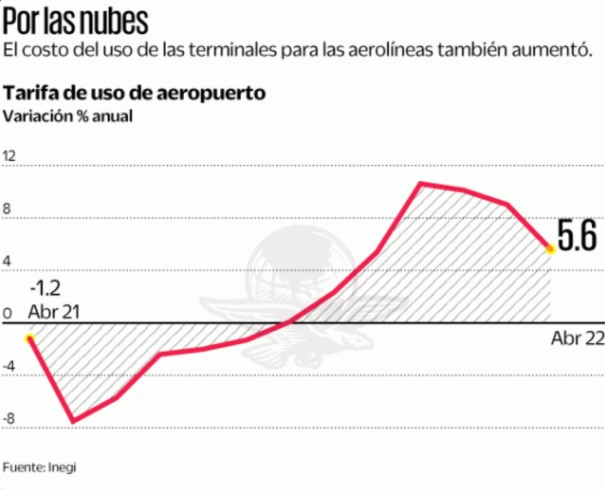
The most important source of income for AICM and all airports in the world is the TUA and, in the case of Benito Juárez, it accounted for 65% of its income last year.

If AICM were in good shape, in operational, financial and technological conditions, it could operate jointly and simultaneously with AIFA, "but this is not the case, one is moribund and the other does not have the size and capacity to absorb the operations of the other."

Machorro said that, for now, the 31 investment projects for the aeronautical sector face budgetary problems that make it unlikely that the next visit for the technical review to be carried out by the Federal Aviation Administration (FAA) of the United States will allow Mexico to return to Category 1.

As of March, information from the SHCP and SICT indicates that there are difficulties in the five main investment projects regarding the resources that were expected to be allocated to them this year.

In the case of the restructuring of airspace and navigation procedures, which involves the purchase of equipment to update the system that integrates the airports of Mexico City, Toluca, Puebla and Cuernavaca, it was originally scheduled to be completed by the end of 2021, but they asked to postpone its completion until next December, meaning that the AIFA started without the system being fully ready.

Regarding the Maintenance and Rehabilitation Program of Runways 05R-23L and 05L-23R at the AICM, which includes cold cutting work on the existing asphalt that must be replaced to correct cracked and deformed areas, as well as other needs, it has a cost of 390 billion pesos and has a physical progress of only 16%.

This program was authorized for 499 million this year, but was given around 192 million.

The replacement of radio navigation aid systems, designed to ensure that aircraft approach and takeoff operations at airports in Pachuca, Loreto, Monclova, San José del Cabo, Villahermosa, San Quintín, Minatitlán, Ixtepec, Tuxtla Gutiérrez, La Paz and Monterrey, continue to operate with high security standards, has not yet been completed, by replacing equipment that has been in operation for more than 15 years.

This project has a cost of 475 million, but despite its importance, it has a physical progress of 0% and it was also necessary to reschedule it.

 class =

Source: El Universal

shutterstock 1684279723 scaled 1

It is becoming more difficult for airports to return to category 1

Experts believe that the incidents at AICM leave the Mexican authorities in a bad position in the face of the inspection by the Federal Aviation Administration of the United States; they see further deterioration.

Next Wednesday marks one year since the Federal Aviation Administration (FAA) downgraded Mexico's aviation safety from category 1 to 2 for failing to comply with International Civil Aviation Organization (ICAO) standards.

At the time, the federal government raised the possibility of recovering the category before the end of 2021 or at the latest in the first months of this year, a situation that did not occur. Experts agree that the possibility of achieving this became more complicated by the recent incidents at the Mexico City airport.

"The many incidents reported will definitely make it difficult to recover to Category 1 status," said Rosa María Montero, a consultant on aviation policy issues.

“For the authority to be able to accredit itself as capable of carrying out reliable operational safety certification processes depends on its selection, hiring and training of the necessary personnel, in number and professional quality,” he added.

To regain the status, Mexico's Federal Civil Aviation Agency (AFAC) would have to submit to its U.S. counterpart, the FAA, a structured and scheduled plan to assess the corrective actions taken and their progress.

When the FAA announced the downgrade, it found 28 points that needed improvement by the AFAC, including an increase in the number of inspectors for certain types of aircraft, updating of training programs, and modification of the Civil Aviation Law.

Inspectors are responsible for analysing incidents and accidents, but also traffic, schedules, itineraries and aircraft maintenance. They must speak aeronautical technical English and be trained according to ICAO standards.

 class =

To Juan Carlos Machorro, expert in aeronautics and airport infrastructure at the Santamarina y Steta firmThese incidents leave the AFAC in a bad position in view of the visit that the FAA has scheduled for these days.

“They have not invested the time, attention or budgetary resources required for this issue. Of the 28 points that the FAA pointed out as a lack of training and economic and human resources, I believe that we are not on the other side. In fact, there has been a deterioration for the past year,” he stressed.

Machorro therefore anticipated that Mexico will remain in category 2 throughout 2022.

“It is not difficult to anticipate this when you cut budget, personnel and an issue comes to light as a result of hiring bias in the case of flight controllers. There is a deteriorated work environment, with fewer salary and budgetary resources that do not allow you to provide adequate maintenance or technology.

“There is no room for austerity in air safety. I hope I am wrong and the government has done its job, but everything is against the audit,” he said.

For Rogelio Rodríguez, former executive of the General Directorate of Civil Aeronautics, AFAC can now recover category 1 status after the next audit, because the aviation law has been modified to ICAO standards, inspectors' income has improved and they have been trained.

However, he acknowledged that incidents involving aircraft approaching the AICM "put the spotlight on American inspectors."

If an accident occurs, it may take another half year to regain status and new files or another audit by the FAA and ICAO will be opened.

The downgrade has led to a loss of market share for Mexican airlines, as they are unable to open new routes to the United States, their main international market.

 class =

Source: El Universal

shutterstock 1978893014 scaled e1652466358200 1

Airspace suffers cost of operating by consultation

The new configuration puts pilots and operators in unnecessary predicaments.

The reconfiguration of the airspace in the Valley of Mexico to accommodate the operation of AIFA has resulted in more problems than solutions and the new configuration puts pilots and air operators in unnecessary predicaments, said Juan Carlos Machorro, partner at the firm Santamarina y Steta.

The partner in charge of the Transactional area and an expert in aeronautics and airport infrastructure, said that the reconfiguration results in longer approach routes, delays, excessive fuel consumption and noise pollution. And this is with AICM operating at 70 percent of the pre-pandemic stage.

Machorro reviewed the counterproductive measures that have generated costs and risks for the Mexican airport system. He stressed that for more than 30 years, all serious feasibility studies have shown that the only viable alternative is Texcoco.

"We are suffering the result of acting on the basis of a consultation without methodological rigor and without any legal basis. Through consultation and decree, the most important airport infrastructure project in the country was cancelled and the forced reconfiguration of a military base was initiated.

"By decree, the management of passengers is intended to be carried out through the Felipe Ángeles International Airport (AIFA) and the AICM has been in intensive care for years due to deteriorating operational and financial health. In addition, he said that by cancelling the Texcoco project, an airport that was destined to close permanently is kept alive.

Now, AICM's main income, the TUA, is transferred entirely to pay the MexCat Bonds, issued to finance the Texcoco project. "AICM's largest income is condemned to pay the debt of a cancelled project, which will not exist for decades to come," he said.

Source: Reform

shutterstock 232490797 scaled e1652459961793

Operating in AIFA puts pressure on airline costs

Asking companies to use both terminals is a lack of commercial sensitivity, experts say.

The agreement with the federal government and airlines to carry out more than 100 daily operations at the Felipe Ángeles International Airport (AIFA) starting on August 15 will increase the operating costs of airlines, which have not yet recovered financially from the pandemic, experts warned.

To operate at both Mexico City International Airport (AICM) and AIFA, companies need ground and air personnel at both terminals, and if they have code-share agreements with foreign airlines, the connection is complicated for flights that arrive in Mexico City but are headed to another destination, which “is a disaster,” said Juan Carlos Machorro, an expert in aeronautics and airport infrastructure at the Santamarina y Steta firm.

“Airlines are a sector that has been particularly hard hit by the pandemic. They have not received a single cent of support from the federal government and are now being forced to stop their operations at AICM and AIFA, which is a lack of commercial sensitivity for these companies, whose profit margins are very low,” explained the analyst.

Machorro said airlines operate from a specific terminal due to economies of scale and code-sharing alliances to facilitate flight connections.

 class =

At the beginning of the Covid-19 pandemic, he recalled, the International Air Transport Association (LATA) recommended that governments suspend investments in the various new airport infrastructure projects and allocate resources to support airlines. “In Mexico, these recommendations were not heeded, and resources were spent on the construction of the project in Santa Lucía,” Machorro stressed. “Now, by decree, the intention is to manage passengers through AIFA,” he said.

On March 17, Aeroméxico concluded its financial restructuring process under Chapter 11. In the first quarter of the year, the airline's revenues were 12 billion pesos, but it reported a net loss of 902 billion.

In addition, the average cost of jet fuel increased by 66% during that period. Now, the airline will operate in Terminal 2 of AICM, where flights from its commercial partner Delta arrive; in Terminal 1, where it occupied some slots left by Interjet, and from AIFA starting in October. 

Between January and March, airlines Volaris and Viva Aerobus reported losses of 980 million and 600 million pesos, respectively.

Pablo Casas Lías, director of the National Institute for Aeronautical Legal Research, explained that when an airport is inaugurated, the process is done in collaboration with airlines. “They do market studies to see if it is profitable to fly from there, if it is convenient for them or if they will generate losses, not on a whim,” he explained.

“Here it is the other way around, they are almost paying them to fly from there (AIFA), with discounts on the TUA (Airport Use Fee), on fuel and on airport services.”

Source: El Universal